Clinical trial outsourcing means hiring an outside partner to run some or all of a human study. For a supplement, device, or ingredient brand, nearly all of the work can go out: protocol, ethics review, recruitment, data capture, analysis, and reporting.
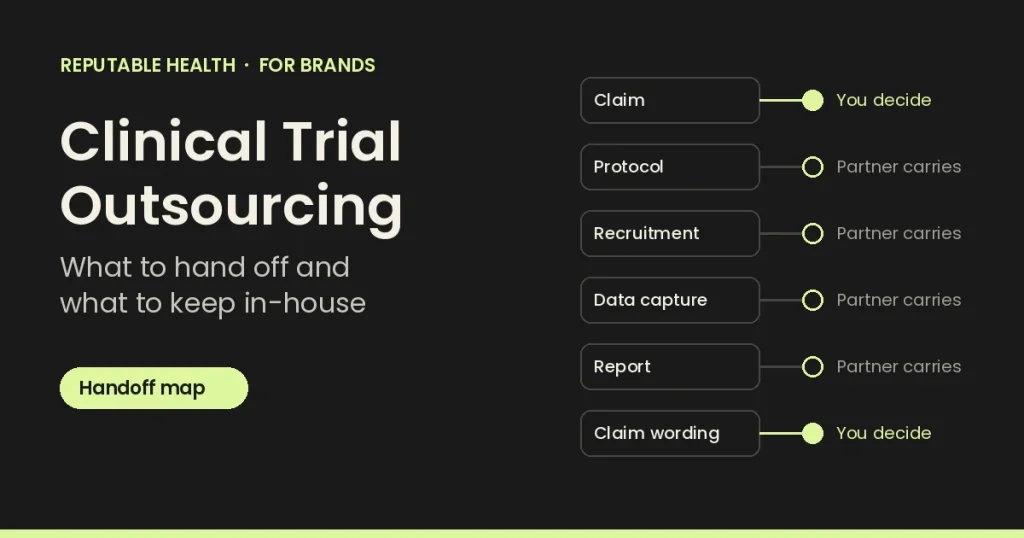
Four decisions should stay with you. They are the claim you want to test, the product you study, the analysis plan, and the claim wording that comes out.
Below is how to pick a model, what to put in writing, and how to oversee the work.
The short answer
- Most of the work can go out. A partner can carry design, ethics review, recruitment, data, and reporting.
- Pick the model by team size. Full-service suits brands and ingredient manufacturers without in-house research staff; functional or hybrid suits teams that already run studies.
- Four decisions stay yours. The claim, the test product, the locked analysis plan, and the final claim wording.
- Write the handoff down. Under Good Clinical Practice, any task not transferred in writing remains the sponsor’s.
- Oversee a few numbers. Track enrollment, adherence, missing data, and safety at set points, and keep the full dataset.
Scope the study before you scope the contract
Bring the product, the claim you want to evaluate, and your timeline. We’ll design a study around them and show you what it takes to get there.
What clinical trial outsourcing covers for a wellness brand
Most guides to clinical trial outsourcing are written for drug developers. A supplement or wellness device study usually starts somewhere else.
- Drug studies. Behind every decision sits an investigational new drug (IND) application, a sequence of numbered phases and a network of hospital sites.
- Structure/function studies. The Food and Drug Administration (FDA) guidance on studies that can run without an IND says a study looking only at a supplement’s effect on normal structure or function generally needs no IND.
- Disease studies. A study of whether a supplement treats or prevents a disease does need one.
The paperwork is lighter, so the quality of the evidence rests more heavily on the choices you and your partner make.
What goes out is the same list a drug sponsor would recognize:
- Design
- Ethics review by an Institutional Review Board (IRB)
- Recruitment
- Product handling
- Data capture
- Safety monitoring
- Analysis
- The report
For a stage-by-stage view, see what a contract research organization does (a CRO, the usual partner for this work).
When a sponsor first talks to Reputable Health, the team asks for four inputs:
- The product. The product or ingredient to be studied.
- The claim. The claim or objective to investigate.
- Existing evidence. Any research the sponsor already holds.
- The timeline. The date the evidence is needed by.
A study design is not on that list. The partner builds the design from the other four.
Pick the outsourcing model that fits your team
Sponsors commonly buy clinical research in four arrangements. The labels come from drug development, and the logic carries over to wellness studies.
Full-service outsourcing
- How it works. One partner runs the whole study, from protocol to report, under one contract.
- Your role. You manage one relationship and keep the decisions, and the partner carries the execution.
- Fits when. A brand with no clinical staff that runs one or two studies a year usually fits here.
Functional outsourcing (FSP)
- How it works. A functional service provider (FSP) takes over one function, such as data management, biostatistics, or monitoring, often across several studies.
- Your role. Your own team runs each study and plugs the provider in where it lacks people.
- Fits when. An FSP arrangement works for a sponsor that already has a study lead and a quality process. Without them, nobody joins the pieces together.
Hybrid outsourcing
- How it works. A hybrid splits the work. One partner carries most of the study while you keep a function in-house or give it to a specialist.
- Example. An ingredient manufacturer with its own statistician might keep the analysis and outsource everything else.
- Fits when. Hybrids hold up when the boundary between the two teams is written down task by task.
Task-level outsourcing
- How it works. Some teams buy single tasks: a protocol review, recruitment for a study they run themselves, or an independent statistical analysis.
- Your role. The scope is small, and the contract is simple.
- Watch for. The risk sits in the gaps between tasks, where no one owns the handoff.
| Model | What goes out | Who coordinates the study | Fits when |
|---|---|---|---|
| Full-service | The whole study | The partner, under your oversight | You have no clinical staff |
| Functional (FSP) | One function, often across studies | Your team | You have a study lead and a quality process |
| Hybrid | Most of the study, with named exceptions | Shared, by a written split | You hold one specialist skill in-house |
| Task-level | Single tasks | Your team | You need a narrow piece of expertise |
Choose full-service when you have no one in-house who has run a protocol, managed an IRB submission, or read a statistical analysis plan. Choose functional or hybrid when you already employ that person and need extra hands for one part of the work. Choose neither yet when you cannot state the claim in one sentence.
A partner can design around a claim, but finding the claim is a strategy question, and no contract answers it.
Keep these four decisions in-house
The Federal Trade Commission (FTC) Health Products Compliance Guidance expects an advertiser to hold a reasonable basis for a health claim before the ad goes out. For most health benefit claims, the guidance says that generally means randomized, controlled human trials.
The duty belongs to the advertiser. Hiring a partner to produce the evidence leaves the claim, and the job of supporting it, with you.
1. The claim you want to test
Why it stays with you. The claim sentence sets the endpoint, the sample size, and the design. A partner left to guess it will usually guess small.
What to do. Write the claim as one sentence before you request a proposal: the benefit, the population, the duration, and the comparison. "Supports sleep quality in healthy adults over four weeks, compared with placebo" can be designed. "Better sleep" cannot.
2. The product that goes into the study
Why it stays with you. The FTC guidance asks advertisers to check that the product studied matches the product sold: dose, formulation, ingredient combination, and the way it is taken. A study of last year’s formula, or of one ingredient from a blend, may not carry over to what is on the shelf.
What to do. Decide which formula and which lot ship to participants. Keep the certificate of analysis in the study file.
3. The analysis plan, locked before enrollment
Why it stays with you. The FTC guidance says primary and secondary outcomes should be defined before the study begins. If the main result is flat, you can’t go back and pick out a small group where the product seemed to work, and use that to back your claim.
What to do. Sign off on the statistical analysis plan before the first participant enrolls. Record any later change as a dated, documented amendment.
4. The claim language that comes out
Why it stays with you. A good partner shows which statements the findings can support and which they cannot. The words that go on a label, a listing, or an ad are your decision, made with qualified regulatory counsel.
What to do. Ask for claim language guidance written for your counsel to review. Treat it as input to that review.
See what a full study hands back
A full clinical study at Reputable covers the protocol, the endpoint and analysis plan, IRB submission, study operations and a report matched to the design. Compare that scope with the handoff your claim needs.
Write the handoff down before the study starts
The international Good Clinical Practice guideline from the International Council for Harmonisation, ICH E6(R3), lets a sponsor hand any or all of its trial activities to a service provider. Final responsibility for participant safety and for reliable data still sits with the sponsor (section 3.6.6).
The same guideline says that transferred activities belong in a written agreement, and that any activity left out of that agreement stays with the sponsor (section 3.6.4). US drug rules make the same point: under 21 CFR 312.52, a drug sponsor’s obligations move to a CRO only as described in writing.
Supplement studies run without an IND fall outside that drug regulation. The principle is still the right one to borrow.
A one-page handoff map does the job. List each activity, who carries it, who decides, and the document that proves it happened.
| Activity | Partner carries | You decide or approve | Written record |
|---|---|---|---|
| Claim and objective | Turns the claim into endpoints and a design | The claim sentence and the decision it supports | Signed study brief |
| Protocol and analysis plan | Drafts the protocol, sample size, and statistical analysis plan | Final sign-off before enrollment | Versioned protocol and analysis plan |
| Ethics review | Prepares the IRB submission and answers queries | Consent materials and study risk | IRB approval letter, approved consent form |
| Test product | Coordinates product shipping to participants and tracks adherence | Formula, lot, and study labeling | Certificate of analysis, shipping log |
| Recruitment and consent | Screens, consents, and enrolls participants | Eligibility that resembles your buyers | Screening and enrollment log |
| Safety | Real-time safety monitoring and escalation of safety events | Product decisions if a safety signal appears | Safety event log |
| Data and analysis | Captures, cleans, and analyzes data per the plan | Any change to the plan | Dataset with codebook, analysis scripts |
| Report and claims | Writes the report, limits included, and claim language guidance | Final claim wording, with counsel | Study report, claim language memo |
Put these terms in the agreement
The commercial contract covers scope, price, and payment. The study’s working terms deserve the same care, and several of them come straight from section 3.6 of ICH E6(R3).
- Deliverables, by name. List the protocol, the analysis plan, the IRB approval, the study report, the participant-level dataset, with a guide explaining each variable, and the analysis scripts, so the evidence never arrives as a slide deck alone.
- Data ownership and access. State who owns the data, when you receive it and in what format, before enrollment opens.
- Records and audits. Agree how long essential records are kept and confirm your right to monitor and audit, two commitments the guideline expects a service provider to make.
- Subcontractors. Ask the partner to disclose any lab, platform, or recruiter it brings in, since the guideline extends sponsor oversight to work a provider passes on (section 3.6.9).
- Quality information. Request the standard operating procedures and performance metrics that apply to your study (section 3.6.8).
- Changes. Define how protocol amendments and scope changes are proposed, priced, and approved, always in writing.
- Reporting cadence. Fix the update schedule and the numbers each update must contain (next section).
- Registration and publication. Decide before enrollment whether the study goes on ClinicalTrials.gov and who may publish the results.
Treat the list as general orientation. Have qualified counsel review the agreement itself.
Oversee the study without running it
Oversight means watching a short list of numbers at agreed points and acting when one drifts. Ask for these in every update.
- Enrollment against plan. Participants screened and enrolled, compared with the target and the date.
- Adherence. The share of participants using the product as directed, and how the partner measures it.
- Retention. Withdrawals to date, with the reason for each.
- Data completeness. Missed surveys, gaps in wearable data, and late lab samples.
- Safety. New adverse events and how each one was handled.
- Protocol deviations. What departed from the protocol and what the team did about it.
Escalate when withdrawals eat into the margin built into the sample size, when wear time on a device endpoint falls below the protocol’s threshold, or when a deviation touches the primary outcome. Stay out of the way when the numbers track the plan. Oversight that turns into running the study adds delay and no quality.
At Reputable, sponsors can receive progress updates, such as enrollment and adherence, at points agreed in the study plan. Continuous wearable data also lets the research team see an unexpected shift while the study is still running, instead of at close-out.
Know what outsourcing cannot fix
A capable partner improves execution. Some problems sit upstream of execution, and no contract moves them.
- A claim the product cannot earn. Good operations make a fair test more likely. They cannot decide which way the result comes out.
- A design chosen for the budget. A small study bought to save money may answer a different question from the one your claim asks, whoever runs it. Work out whether to run a pilot first before you request quotes.
- The limits of a remote study. A decentralized study trades some control over conditions for reach and real-world data, so each endpoint needs a device or instrument that holds up at home. The trade-offs are laid out in this comparison of centralized and decentralized trials.
- Late changes on your side. A claim that shifts after enrollment, or a formula that changes mid-study, breaks the link between the evidence and the ad.
Where Reputable fits
Reputable Health is a full-service decentralized CRO for health and wellness brands and ingredient manufacturers. The guidance above applies to whichever partner you choose.
- Two offerings. A pilot study and a full clinical study, and the scope follows your question.
- One team. A single team handles the protocol and IRB submission, then enrollment, data capture, analysis, and the report, which keeps the handoff map short. The steps are set out in how a Reputable study comes together.
- Independent review. Studies go through independent Institutional Review Board review, and the review pathway follows the study design.
- Measurement. Consumer wearables (Oura, WHOOP, Apple Watch, Garmin, Fitbit), validated surveys, and at-home lab kits processed through CLIA labs.
- Deliverables. A complete study report, the agreed dataset, and claim language guidance written for your counsel to review.
- Limits. A pilot is not automatically designed to substantiate a product claim, and a positive finding is not guaranteed.
- Pricing. Every study is scoped to your product, your claims, and your budget.
By Reputable’s own count:
| Measure | Figure |
|---|---|
| Research community | 10,000+ participants |
| Returning participants | 82%, already vetted and study-ready |
| Compliance rate | 87% across its most recent completed clinical studies |
| Sponsored studies | 70+, excluding public learning studies |
Frequently Asked Questions
Five questions brand and ingredient teams raise before they hand a study to a partner.
Is clinical trial outsourcing only for drug companies?
No. The models grew up in drug development, but supplement, device, ingredient, and behavioral program sponsors outsource for the same reason: they need research capacity they do not keep on staff.
How many partners should one study have?
One accountable lead is easier to oversee than several. If you use more than one, name the partner that coordinates the others and put that role in the agreement.
Should the same partner run the pilot and the full study?
Often it helps, since the team that ran the pilot already knows the recruitment, adherence, and measurement problems it surfaced. Keep the choice open in the agreement, and make sure the pilot’s protocol and dataset are yours to hand to another partner.
How long does an outsourced study take?
Duration follows the design: eligibility, sample size, measurements, how long participants use the product, and the reporting scope. Ask each partner to show how those choices move the timeline, and compare the reasoning instead of the headline dates.
Does outsourcing make the results independent?
Not by itself. You still fund the work and own the claim. The FTC guidance gives extra weight to results that independent researchers replicate, so disclose who paid for the study and build it so it can fail.
The bottom line
Outsourcing a clinical study moves the work to people who do it every day. The claim, the product, the analysis plan, and the final wording stay with you, along with the duty to support whatever your ads say.
Before you sign with anyone, write the claim sentence and a one-page handoff map. Bring both to the first proposal meeting, and judge each partner by how precisely it fills in the gaps.
Start with the claim, then the contract
Tell us the product, the claim you want to evaluate, and the date you need evidence by. We will sketch the study and show which parts of the handoff your team should keep.
About the author
Mackenzie De Jesus, DHSc, MS, Head of Clinical Research. Mackenzie De Jesus leads clinical research at Reputable Health, where she designs and runs decentralized studies that pair wearable data with validated participant-reported outcomes.