A contract research organization (CRO) is an outside firm a sponsor pays to carry out some or all of the work of a human study, from protocol to final report. The label sounds precise. In practice, it covers companies with very little in common.
For a supplement, device, or ingredient brand, the useful question is narrower: which kind of CRO can produce the evidence your claim needs?
Here are the five kinds you will meet, the services that only resemble a CRO, and a way to match each one to your claim.
The short answer
- The label is broad. Any firm that takes on even one of a sponsor’s study duties can call itself a CRO.
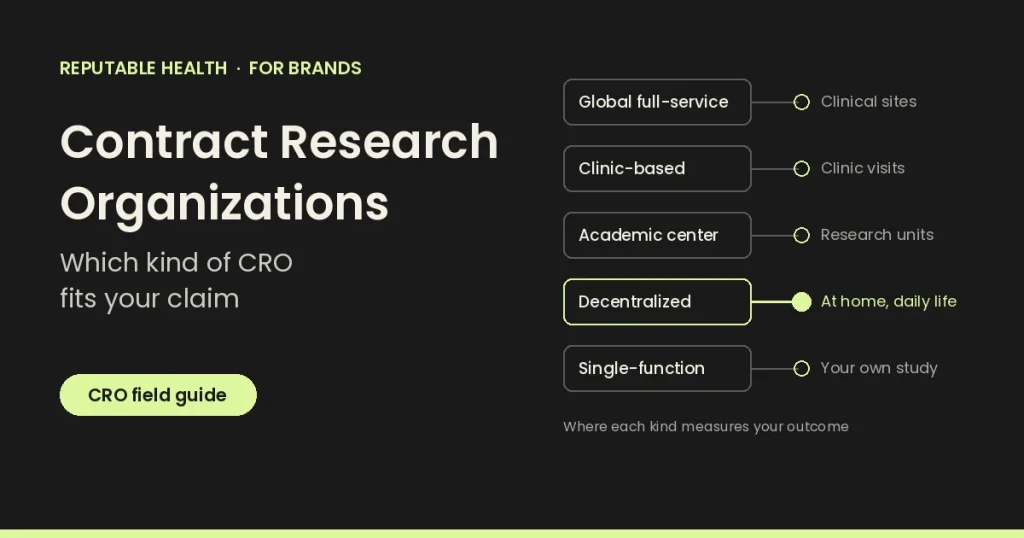
- Five kinds matter. Global full-service, clinic-based nutraceutical, academic, decentralized, and single-function CROs differ most in what they can measure.
- Lookalikes answer other questions. Perception panels, testing labs, seals, and self-serve software do not produce a controlled study of your product.
- The claim picks the CRO. Health benefit claims generally call for randomized, controlled human trials, so shortlist kinds that can run one.
- Write the claim first. Then ask each candidate who designs, who recruits, and what you keep at the end.
Find the study before you find the vendor
We’ll talk through the design your claim calls for and how we’d run it.
Why the CRO label covers such different companies
US drug regulations give the formal definition. Under 21 CFR 312.3, a CRO is an independent contractor that assumes one or more of a sponsor’s obligations, such as writing a protocol, monitoring the investigation, or evaluating reports.
“One or more” is why the category is so wide. A firm that only cleans data and a firm that runs an entire multi-country program both fit the definition.
For a basic walkthrough of each stage, see what a CRO does in a clinical trial. The definition above comes from drug law, and three things change once the product is a supplement:
- No premarket approval. The Food and Drug Administration (FDA) has no authority to approve dietary supplements before they reach the market, so a supplement study is not building toward an FDA approval.
- Usually no drug application. FDA’s 2013 guidance on investigational new drug (IND) applications says a study that looks only at how a supplement affects the body’s normal structure or function does not need an IND. A study of whether it treats or prevents a disease does.
- The bar comes from advertising law. The Federal Trade Commission (FTC) sets the evidence standard for health claims in advertising (more on that below).
Much of the drug-specific regulatory work, such as IND filings and FDA approval steps, doesn’t apply to a wellness study. What separates one kind of CRO from another, for you, is the design it can run and where it can measure your outcome.
Reputable Health is listed as a collaborator on randomized, placebo-controlled decentralized trials registered on ClinicalTrials.gov. The distinctions below come from running those studies for brands like yours.
Know the five kinds of CRO you will meet
Each card below describes how that kind of CRO commonly works. Individual firms vary, so treat the cards as a starting map.
Global full-service CROs
- Built for. Drug, biologic, and medical device programs, often spread across many countries and research sites.
- Best at. Large multi-site studies and the regulatory documentation that drug and device pathways require.
- Ask about. Which parts of their standard process a structure/function study can skip, and who on their team will actually run a study of your size.
- Evidence it produces. Whatever design you specify, usually measured at clinical sites.
Clinic-based nutraceutical CROs
- Built for. Supplements, functional foods and other consumer health products, studied at the CRO’s own clinics or partner sites.
- Best at. Endpoints that need a clinic: supervised physical or cognitive tests, imaging, body composition scans, and blood draws on a fixed schedule.
- Ask about. How far participants travel and how often, since visit burden shapes who enrolls and who stays to the end.
- Evidence it produces. Controlled measurements taken at scheduled visits, plus diaries or apps between visits if the protocol adds them.
Academic research centers
- Built for. University departments and hospital research units that accept industry-funded studies.
- Best at. Deep expertise in one scientific area and mechanistic questions an investigator already studies.
- Ask about. Who negotiates the agreement, how the institution treats publication rights, and how long its contracting and review steps usually take.
- Evidence it produces. Often a tightly controlled study in a narrow population, aimed at journal publication.
Decentralized CROs
- Built for. Products people use at home, such as supplements, wearable devices, and behavioral programs.
- Best at. Outcomes that happen in daily life, captured with consumer wearables, validated surveys, and at-home lab kits, with enrollment that is not tied to one city.
- Ask about. Which device metrics count as endpoints, the minimum wear time, and how the analysis plan handles missed nights and skipped surveys.
- Evidence it produces. Repeated real-world measurements throughout the study, in single-arm or placebo-controlled designs. The mechanics are covered in how decentralized clinical trials work.
Single-function specialists
- Built for. Sponsors that run their own studies and need one function filled: biostatistics, data management, monitoring, or recruitment.
- Best at. Depth in that one function, often across several studies at once.
- Ask about. Who on your side writes the protocol and joins the pieces together, because a specialist will not.
- Evidence it produces. Only what your team’s study design produces. The specialist strengthens one part of it.
Reputable is a full-service decentralized CRO, one of the kinds in this table, so we’ve noted where other kinds are the better fit.
| Kind of CRO | Where participants take part | Fits a brand or ingredient manufacturer when |
|---|---|---|
| Global full-service | Clinical sites, often in several countries | The product is on a drug or device pathway |
| Clinic-based nutraceutical | The CRO’s clinics or partner sites | The endpoint needs supervised, in-person measurement |
| Academic research center | University or hospital research units | The question is mechanistic and an investigator already studies it |
| Decentralized | At home, with remote follow-up | The outcome can be measured in daily life |
| Single-function specialist | Wherever your own study runs | Your team already leads studies and lacks one skill |
For a closer look at two of these rows, see the decentralized and site-based comparison.
Tell a CRO apart from services that resemble one
Several services sold to wellness brands sit close to the CRO category. Each one answers a real question. None of them, by itself, delivers a controlled human study of your finished product.
| Service | Question it answers | What it does not produce | Enough on its own when |
|---|---|---|---|
| Consumer perception study | What do users notice and report after using the product? | A comparison against placebo | You plan to make perception or satisfaction statements, worded as such |
| Product testing lab | What is in the product, and in what amounts? | Any evidence of an effect in people | You need identity, potency, or purity data |
| Certification or seal program | Does existing evidence meet the program’s criteria? | New evidence about your product | You already hold evidence and want it reviewed |
| Ingredient literature review | What do published studies say about the ingredient? | Evidence for your formula, dose, and format | You are choosing which ingredient to build on |
| Self-serve research software | Can our own team run a study? | A team to run it for you | You employ people who have run studies before |
The distinction matters because of how regulators read claims. The FTC’s Health Products Compliance Guidance holds claims that consumers cannot easily judge for themselves, such as benefits open to a placebo effect, to a more exacting standard.
Perception data has its place in marketing. The same gap explains why clinically tested and clinically proven mean different things on a label.
Test the signal before you size the study
A pilot study looks for an early signal and shows whether recruitment, adherence, and measurement work for your product. See what a pilot includes and the decisions it can and cannot support.
Match the CRO type to your claim
The claim sets the design, and the design narrows the list of CROs that can run it. The FTC guidance (December 2022) asks for competent and reliable scientific evidence behind health benefit claims, and says randomized, controlled human trials are generally what experts expect for them.
The same guidance favors double blinding, where neither participants nor researchers know who received the product. A CRO that cannot randomize, blind, and hold a placebo arm on your endpoint can still be useful. For a health benefit claim, though, you need a partner that can do all three.
Choose a decentralized CRO when the product is used at home, the primary outcome can be tracked as people go about their week (sleep timing, heart rate variability, step counts, or a validated survey score), and you want participants from across the country.
Choose a clinic-based CRO when the primary endpoint needs supervision or equipment, such as imaging, a timed blood draw, or a lab-administered performance test, or when participants need observation after taking the product.
Choose an academic center when a named investigator already studies the mechanism behind your ingredient, and you can work to the institution’s timelines.
Choose a global full-service CRO when the study is meant to show that a product treats or prevents a disease. That question generally brings drug rules and an IND into play, and those firms are built for it.
Choose a single-function specialist when your company already employs someone who has led a protocol through ethics review and analysis.
Hold off on all five when the claim is still a direction instead of a sentence with a benefit, a population, a time frame, and a comparison.
Pick the CRO that can run the design your claim needs, then let the budget shape the size of the study.
Ask five questions that reveal the CRO type
Sales decks blur these categories, so ask questions whose answers cannot be blurred. The International Council for Harmonisation (ICH) guideline E6(R3), the global standard for Good Clinical Practice (GCP), places the job of assessing a provider’s suitability and selecting it on the sponsor (section 3.6.7).
- Who will participants deal with during the study? Site staff point to a clinic-based or full-service CRO. A study team that works with participants through an app and remote check-ins points to a decentralized CRO. Your own staff point to software or a specialist.
- Who drafts and signs off on the protocol and the statistical analysis plan? A full CRO drafts both for your approval. If the answer is that you upload your own, you are buying a tool or a single function.
- Who submits the study to the Institutional Review Board (IRB)? A CRO prepares the submission and answers the board’s questions. Ask as well how the review pathway changes with the design.
- Where will participants come from? Clinic databases, an existing research community, your customer list, and paid panels each shape who enrolls, and how closely they resemble the people who buy your product.
- What will you hold when the study ends? A study report with the participant-level dataset and its codebook is a study. A dashboard, a score, or a seal is a different product.
What no CRO can do for you
Every kind of CRO improves execution. Some limits sit above execution, and no choice of partner removes them.
- Choose your claim. A CRO can turn a claim into endpoints. What your brand wants to say stays a business and regulatory decision.
- Carry your responsibility. The same ICH guideline lets a sponsor hand any or all study activities to a provider, while ultimate responsibility for participant safety and data reliability stays with the sponsor (section 3.6.6).
- Promise an outcome. A positive finding is not guaranteed, regardless of which kind of CRO runs the study.
- Stretch a design. A pilot is not automatically designed to substantiate a product claim. Settle whether a pilot should come first before you compare proposals.
- Make the study independent. A study you fund remains your study, whoever runs it. The FTC guidance gives added weight to results that independent researchers replicate.
Claim wording and regulatory strategy belong with qualified regulatory counsel, whichever kind of CRO you hire.
Where Reputable fits
Reputable Health is a full-service decentralized CRO that designs and runs clinical studies for health and wellness brands and ingredient manufacturers. We sit in one row of the table above, which gives us a stake in your choice.
- Two offerings. Reputable runs a pilot study and a full clinical study, and the scope follows your question.
- How it differs. Decentralized studies remove the need for clinic visits, which often makes them quicker to enroll and less costly to run.
- Measurement. Participants wear consumer wearables such as Oura, WHOOP, Apple Watch, Garmin, and Fitbit, answer validated surveys, and, when the protocol calls for it, send at-home lab kits that are processed through CLIA labs (CLIA refers to the Clinical Laboratory Improvement Amendments). The full list is under the measures Reputable runs.
- Ethics review. On the oversight side, studies go through independent Institutional Review Board review, and the review pathway follows the study design.
- When to look elsewhere. If your primary endpoint needs imaging, supervised testing, or clinic observation, a clinic-based CRO is the better fit, and we will say so.
- Pricing. No two quotes look alike, since every study is scoped to your product, your claims, and your budget.
Figures Reputable reports for its own work:
| What Reputable reports | Figure |
|---|---|
| Participants in its research community | 10,000+ |
| Participants who are returning, already vetted and study-ready | 82% |
| Customers in under two years | 40+ |
| Compliance rate across its most recent completed clinical studies | 87% |
Frequently Asked Questions
Four questions brand and ingredient teams ask while they compare kinds of CRO.
Does a supplement brand need a CRO to run a study?
No rule requires one. FDA’s drug regulations even describe a sponsor that runs its study with its own employees, and supplement studies carry no CRO requirement either. A brand without research staff still needs every piece a CRO would supply, from protocol and ethics review to analysis.
Can a small brand work with a large full-service CRO?
Yes, though fit matters more than size. Ask who will run the study day-to-day and how much of the standard process applies to a structure/function study.
Is a decentralized study less rigorous than a site-based one?
Rigor comes from the design: randomization, blinding, an analysis plan fixed in advance, validated instruments, and independent ethics review. Moving measurement into daily life gives up some control over conditions and gains reach, so each endpoint needs an instrument that works at home.
Should we get proposals from more than one kind of CRO?
Yes, when your endpoint could be measured either at home or in a clinic. Comparing the designs each kind proposes shows you the tradeoff before you commit to one.
The bottom line
“CRO” names a role, and very different companies fill it. The kind you hire decides where your outcome is measured, which designs are possible, and what you hold at the end.
Before your first call, write the claim as one sentence and note where its primary outcome can be measured. Shortlist only the kinds of CRO that can run that design, then put the five questions to each one.
Bring the claim, leave with a design
Tell us the benefit you want to evaluate, who the product is for, and your timeline. We will sketch a study that fits it and be clear about what that design can and cannot support.
About the author
The Reputable Team. Reputable Health designs and runs decentralized clinical studies for health and wellness brands and ingredient manufacturers. We share practical guidance on study design, interpreting results, and understanding what the evidence supports.